By Harriette Luscombe: Westside Wellness Consultant
There’s a reason why the world’s most prolific innovators—from Steve Jobs to the thinkers who designed the very skyline of Birmingham—shared a singular habit: the walking meeting. As we celebrate National Walking Month this May, we’re looking at how to pair our world-class Westside office spaces with the vibrant, architectural stretch of the BID’s central postcodes.
This isn’t about trading in the desk for the pavement; it’s about a high-performance psychological “add-on.” Think of the walking meeting as the ultimate accompaniment to your boardroom strategy—a way to unlock a level of creative flow that only movement can provide.
Moving Beyond “Cognitive Tunneling”
In high-pressure environments, psychologists often warn of Cognitive Tunneling. It’s a term brought to the forefront by researchers like Neville Moray to describe a state where our focus becomes so narrowed on a single “problem” that we lose the ability to see the wider solution. While our offices in Brindleyplace and around Five Ways are perfect for deep execution, sometimes a complex strategy needs a broader lens.
Research from Stanford University (Oppezzo & Schwartz, 2014) found that walking increases creative output by an average of 60%. Interestingly, the study showed that while walking anywhere boosts the volume of ideas, the “divergent thinking” required for high-level strategy is beautifully supported by the sensory shift of being on the move.

Photo by Vitaly Gariev
The Power of “Side-by-Side” Psychology
There is a profound psychological shift that happens when we stop sitting across a desk from someone and start walking beside them. In a traditional setting, direct eye contact is vital but can occasionally feel intense during difficult negotiations.
When you walk side-by-side toward Five Ways, you enter a state of Joint Attention. Because you are both facing the same direction, the hierarchy flattens. Research suggests this “collinear” positioning reduces social anxiety and encourages more collaborative, honest dialogue. It’s the psychological equivalent of “we’re in this together,” making it the perfect setup for tackling big-picture goals.
The “Blue Space” Advantage
We often talk about “Green Space,” but Westside offers the incredible benefit of “Blue Space”—the canals. Positive psychology’s Attention Restoration Theory (ART) suggests that natural environments allow our “directed attention” (the hard-working part of your brain) to rest. A quick loop around the Gas Street Basin allows your mind to “recalibrate,” meaning you return to your desk with more focus than when you left.
Top Tips for a Westside “Walk-and-Work”
● The Intentional Start: Start the walk by setting the “destination goal.” For example: “By the time we reach the Library of Birmingham, let’s have three options for the project launch.”
● The Five Ways Loop: For a 30-minute session, head from the Water’s Edge toward Five Ways. The mix of historic canal-side charm and the leafy borders provides the perfect “sensory snack” for a tired brain.
● Dictate, Don’t Type: Use your phone’s voice-to-text feature to capture the “lightbulb moments” as you walk. This keeps your hands free and your posture open.
● The “Rule of Two”: Walking meetings are most effective as a duo. This preserves the side-by-side psychological benefit and ensures clear communication over the city’s hum.
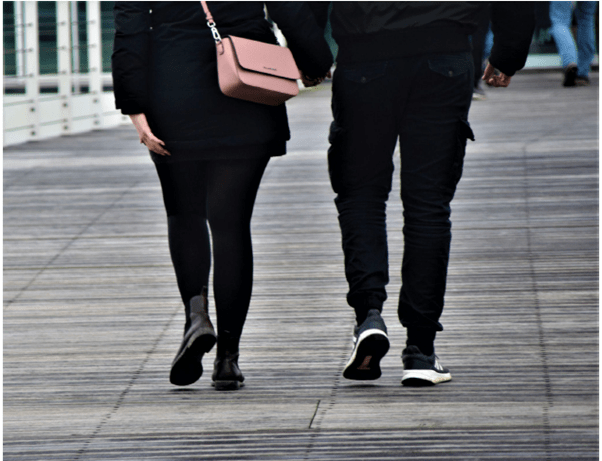
Photo by Waldemar Brandt
The Bottom Line
Walking isn’t just “wellbeing”—it’s a sophisticated productivity tool. This May, as part of National Walking Month, why not add a “Mobile 1:1” to your calendar? Our offices give us the space to build, but the Westside’s pathways give us the space to dream. By combining the two, you aren’t just working